Blog
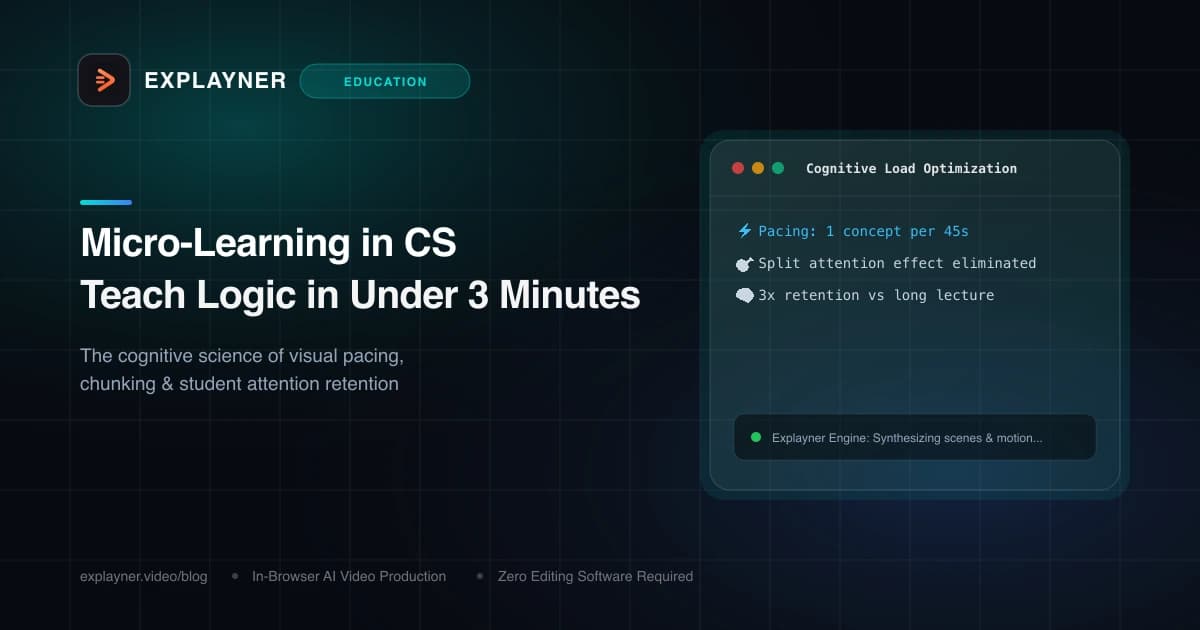
Micro-Learning in Computer Science: How to Teach Complex Logic in Under 3 Minutes

The 10-Minute Attention Cliff in Technical Education
If you teach computer science - whether at a university, a high school, an online course, or an intensive bootcamp - you know the blank stares. Around minute 12 of a lecture on binary search trees or pointers, cognitive fatigue sets in.
Programming is intellectually unforgiving. Unlike subjects where missing a sentence allows you to infer the meaning from context, missing a single line of logic makes everything that follows incomprehensible.
This is where micro-learning transforms technical education. By isolating one conceptual hurdle and presenting it within a tightly paced, 3-minute visual explainer, students achieve high comprehension without cognitive overload.
Cognitive Load Theory: Why Less Is So Much More
Educational psychologist John Sweller established Cognitive Load Theory, which outlines how our working memory has extremely limited capacity. In computer science, students face three distinct cognitive loads:
- Intrinsic load: The inherent difficulty of the programming concept itself (e.g., how recursion unwinds).
- Germane load: The beneficial mental processing that forms permanent schemas and problem-solving patterns.
- Extraneous load: The unnecessary friction introduced by poor presentation - cluttered IDEs, disorganized slides, mouse jitter, or monotone audio.
The Split-Attention Effect
When students must look back and forth between a presenter's face, a messy code window, and a chat box, extraneous load skyrockets. Clean animated slides that center attention on one line at a time reduce extraneous load by up to 70%.The 3-Minute Lesson Blueprint
How do you fit a complex CS topic into under 180 seconds? Use this proven pedagogical structure:
- 0:00 - 0:25 (The Real-World Hook): State the problem without code (e.g., 'How does Spotify search 100 million songs in 5 milliseconds?').
- 0:25 - 1:45 (The Visual Mechanism): Show the algorithmic intuition using animated blocks or cards. Let the visual motion teach the rule before introducing syntax.
- 1:45 - 2:30 (The Code Translation): Display a 5-line implementation. Highlight variables as they update in real time.
- 2:30 - 3:00 (The Edge Case & Recap): Summarize the Big-O time complexity or warn against a common pitfall (like infinite recursion).
Create with Explayner
Turn your idea into a ready-to-post video.
Upload audio, a talking-head clip, or a simple prompt and start creating in your browser.
Producing Course Micro-Videos with Explayner
Computer science instructors rarely have the time to become professional video editors. Grading, lesson planning, and mentoring leave zero room for multi-hour video editing sessions.
With Explayner, instructors can record a voice memo while walking to class or dictate a short script. Explayner generates clean visual scenes, adds automated captions for ESL students, and handles background music balance.
If you want to position your webcam in the corner to maintain that personal teacher-student connection, Explayner gives you 8 distinct layout positions that never block the code.
The Impact on Student Outcomes
When educators replace long lecture recordings with 3-minute micro-videos, student behavior changes dramatically. Re-watch rates go up, forum questions become more specific, and exam failure rates drop.
Give your students the gift of focus. Break your next lecture topic into three-minute visual modules, and watch their understanding soar.
Create with Explayner
Turn your idea into a ready-to-post video.
Upload audio, a talking-head clip, or a simple prompt and start creating in your browser.